In an era defined by rapid technological shifts, the education landscape is experiencing an unprecedented paradox. On one hand, students have access to more information than any generation before them. On the other hand, core conceptual understanding and critical thinking skills are under severe threat.
The culprit isn’t technology itself, but rather how it is being utilized.
When OpenAI released ChatGPT, it was hailed as a universal tutor. Millions of students globally began using generic generative pre-trained transformers (GPTs) to help with homework, write essays, and solve complex mathematical equations. However, a few years into this massive, unscripted experiment, educators and cognitive scientists are noticing a troubling trend: generic AI models are acting as cognitive crutches rather than educational catalysts. They provide answers, but they do not cultivate knowledge.
To build true academic resilience and long-term retention, the paradigm must shift from answer automation to cognitive scaffolding. This is where specialized, pedagogical AI systems like Thinkmate AI—integrated within modern learning ecosystems like Skolar24 are fundamentally changing the game.
This deep dive explores the cognitive science behind learning, the structural flaws of using generic GPTs for education, and why a purpose-built AI guide is essential for developing true, foundational knowledge.
1. The Cognitive Cost of the “Instant Answer” Culture
To understand why generic GPTs fail as effective learning tools, we must first look at how the human brain processes, stores, and retrieves information.
Learning is not a passive act of consumption; it is an active process of construction. According to Cognitive Load Theory, formulated by John Sweller in the late 1980s, our working memory has a remarkably limited capacity. For information to move from transient working memory into permanent long-term memory, the brain must actively process the material, forming mental frameworks known as schemas.
The Problem with Direct Answers
When a student encounters a difficult calculus problem or a complex physics concept and inputs it into a generic GPT, the model instantly outputs the final answer, often accompanied by a fully completed, step-by-step resolution.
While this looks helpful on the surface, it causes two massive cognitive failures:
- Bypassing the “Generation Effect”: Cognitive psychology shows that individuals remember information better if it is generated from their own mind rather than read from a page. By providing the answer upfront, generic GPTs completely eliminate the generation effect.
- The Illusion of Competence: When a student reads a perfectly formatted solution generated by an AI, their brain experiences a false sense of understanding. They mistake the clarity of the AI’s output for their own mastery of the concept. This illusion shatters the moment they sit in an exam hall without the technology.
2. Vygotsky’s Zone of Proximal Development and the Socratic Method
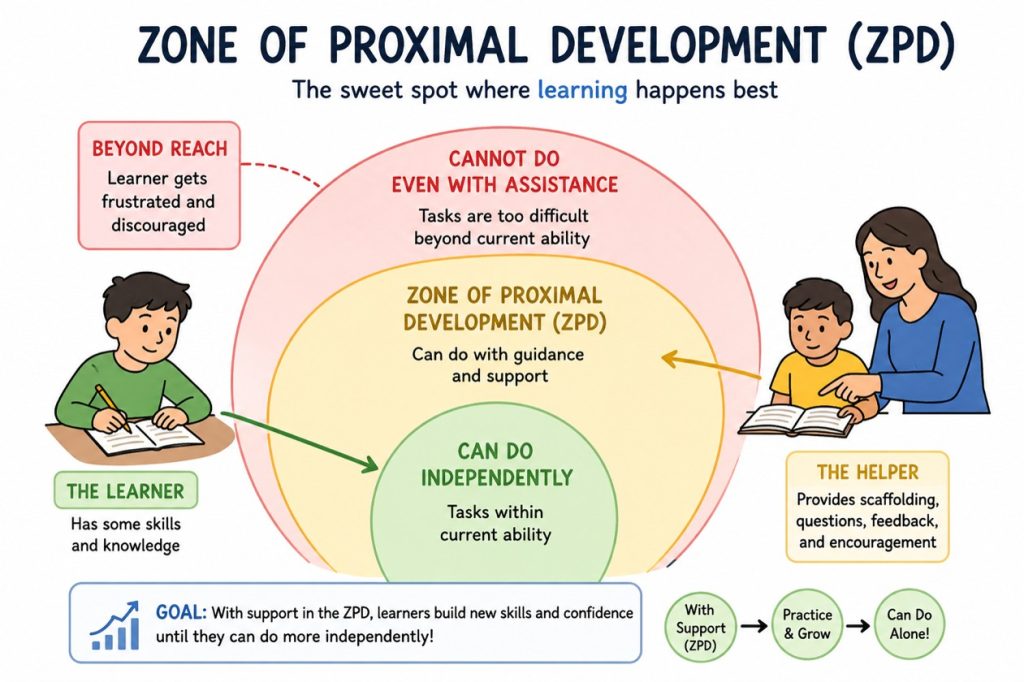
True education takes place in what psychologist Lev Vygotsky termed the Zone of Proximal Development (ZPD). The ZPD is the sweet spot between what a learner can do independently and what they cannot do even with assistance. Effective instruction requires scaffolding—temporary support that helps the learner navigate this zone until they can perform the task unassisted.
Why Generic GPTs Fall Outside the ZPD
Generic GPTs are inherently transactional. They are optimized for efficiency, completion, and direct utility. When a student uses them, the AI completely crosses the ZPD for the student, performing the cognitive heavy lifting itself. It acts as a co-author or a proxy problem-solver, not a teacher.
The Thinkmate AI Difference: Guardrails and Guidance
A purpose-built pedagogical engine like Thinkmate AI is engineered with structural, educational guardrails. It doesn’t give answers; it gives direction. It employs the Socratic Method, a form of cooperative argumentative dialogue that stimulates critical thinking and draws out ideas and underlying presuppositions.
If a student inputs a chemistry equation into Thinkmate AI, the system doesn’t balance it for them. Instead, it might respond:
“I see you’re working on balancing a redox reaction. Before we look at the coefficients, let’s look at the oxidation state of the nitrogen atom on the reactant side. Can you tell me what it is?”
This subtle shift forces the student back into active learning. The AI serves as an interactive scaffold, gradually receding as the student demonstrates competence.
3. The Structural Dangers of AI Hallucinations and Lack of Pedagogical Intent
Generic LLMs are probabilistic text predictors. They do not possess an internal model of objective reality or pedagogical theory; they predict the most likely next word based on vast datasets.
This introduces two distinct hazards for students:
1. Authoritative Hallucinations
Generic GPTs can hallucinate facts, equations, and historical timelines with absolute confidence. For an adult professional, detecting a hallucination might be simple based on industry experience. For a student who is learning a concept for the very first time, a confidently stated mathematical error or false historical narrative can permanently distort their foundational knowledge.
2. Lack of Curriculum Alignment
A generic AI has no context regarding a student’s current academic level, regional curriculum, or prior learning history. It might explain a basic algebraic concept using advanced multivariable calculus notation, causing immediate cognitive overload and frustration.
Conversely, a dedicated learning platform aligns its AI capabilities directly with specialized diagnostic tools, structured personal learning paths, and human micro-tutoring frameworks. It knows exactly what the student should know at their specific level, ensuring the conversation remains contextually appropriate and educationally sound.
4. Head-to-Head Comparison: Generic GPT vs. Thinkmate AI
To clarify the structural differences between these two approaches, the table below highlights how a generic chatbot compares to a purpose-built cognitive guide across critical learning metrics.
| Feature / Dimension | Generic GPT Chatbots | Thinkmate AI (Skolar24 Platform) |
| Primary Objective | Task completion, speed, and immediate output. | Conceptual clarity, retention, and independent mastery. |
| Response Strategy | Deliver the final answer directly with complete steps. | Provide hints, ask clarifying questions, and scaffold learning. |
| Cognitive Load | Low mental effort (leads to passive dependence). | Optimized mental effort (fosters active recall). |
| Error Handling | Apologizes and changes the answer when challenged, even if it was right. | Identifies the student’s specific misconception and guides them to correct it. |
| Curriculum Context | None. Treats every query as an isolated, universal prompt. | Fully integrated with AI-powered assessments and targeted topic paths. |
| Human Integration | Isolated tool; completely detached from human educators. | Seamlessly bridges gaps, signaling when to leverage short-term expert human tutors. |
5. Overcoming the “Desirable Difficulties” Hurdle
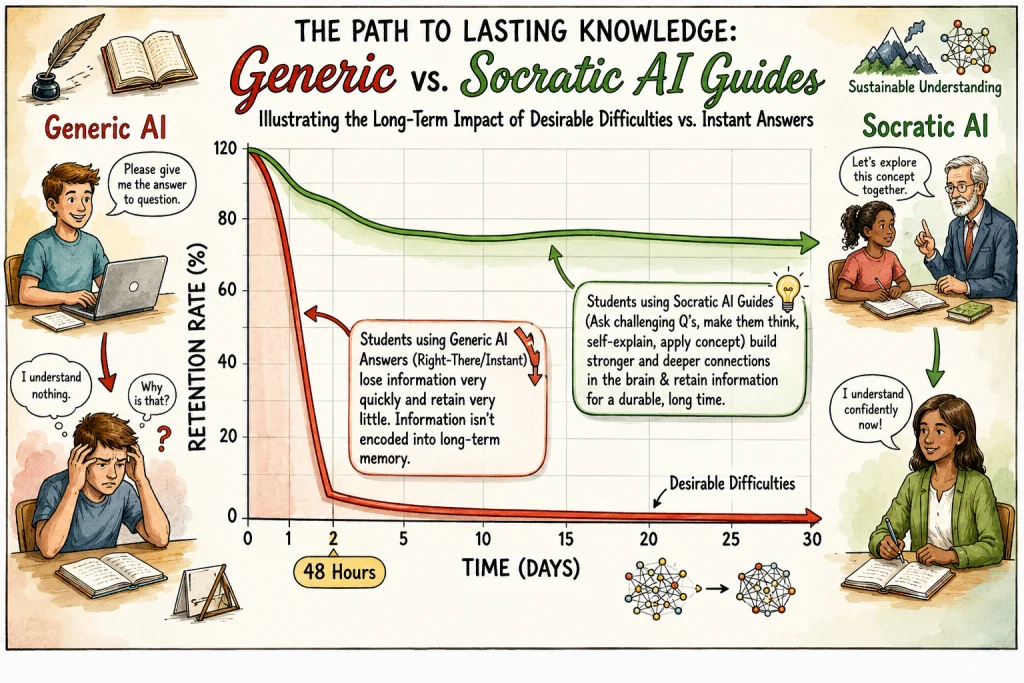
In 1994, cognitive psychologists Robert and Elizabeth Bjork introduced the concept of “Desirable Difficulties.” Their research proved that introducing certain short-term challenges and obstructions into the learning process actually triggers deeper processing, leading to significantly better long-term retention and transfer of knowledge.
Easy, Instant AI Answers] —-> Fast Completion —-> Rapid Forgetting
Desirable Difficulties / Hints] -> Mental Effort —> Deep Long-Term Schema Setup
Generic GPTs are designed to eliminate all friction. They make learning “easy”, which is precisely why they make learning ineffective. When information is acquired with zero effort, it is forgotten with equal velocity.
Thinkmate AI deliberately re-introduces desirable difficulties into the digital learning workflow.
- It requires the student to type out their reasoning.
- It asks them to identify where they are stuck.
- It challenges them to try an alternative approach if their first attempt fails.
By introducing this deliberate, productive friction, the platform transforms a passive smartphone user into an active intellectual agent.
No matter how advanced an artificial intelligence becomes, human learning is fundamentally social. We co-regulate our attention, emotional connection, and motivation through human interaction.
6. The Synergy of Guided AI and Short-Term Human Tuition Exchange
This is where the ecosystem design becomes critical. A standalone generic GPT leaves a student completely isolated in a digital silo. If they get stuck or frustrated, their only option is to ask the chatbot to “just give me the answer.”
A structured ecosystem like Skolar24 creates a dynamic flywheel between the student, the AI guide, and human expertise:
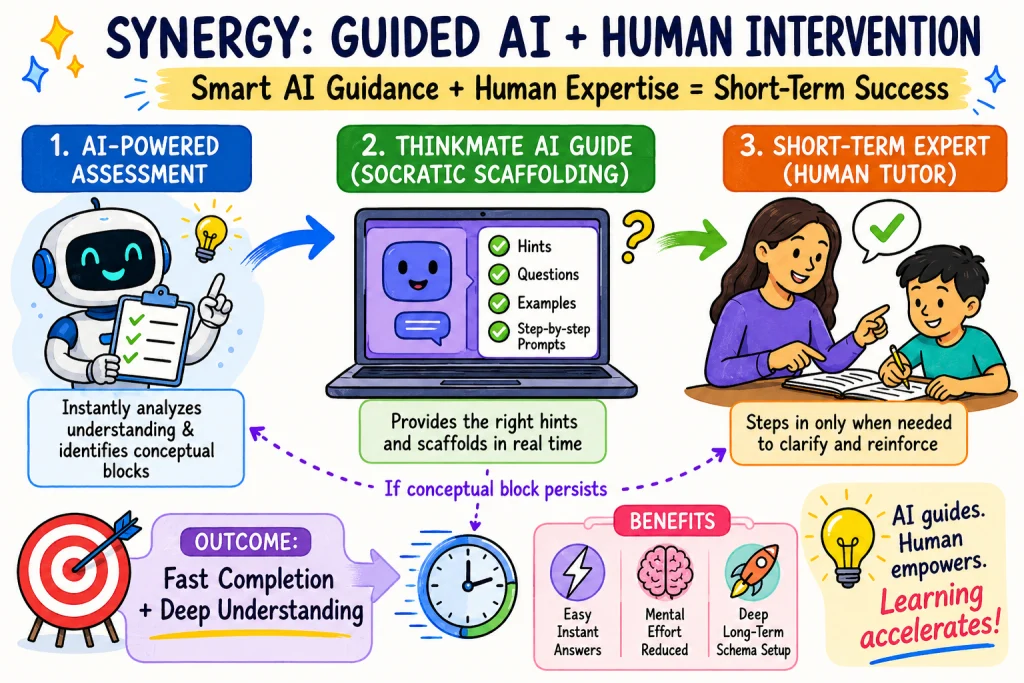
- Diagnostic Evaluation: Continuous AI-powered assessments map out exactly what a student understands and identify precise skill gaps.
- First-Line Engagement: When tackling a difficult homework assignment or exam preparation, the student collaborates with Thinkmate AI. They struggle productively, receive contextual hints, and clear up minor misunderstandings on their own.
- Targeted Micro-Tutoring Escapes: If a deep-seated conceptual barrier persists, the system doesn’t break its pedagogical rules by revealing the answer. Instead, it seamlessly connects the student with an expert human tutor through a short-term tuition exchange focused on that exact, isolated topic.
This ensures that human intervention is highly targeted, incredibly efficient, and remarkably affordable. The student doesn’t need months of generic tuition; they need twenty minutes of laser-focused clarity on a specific concept that the AI precisely identified.
Conclusion: Choosing Transformation Over Transaction
As AI becomes deeply woven into the fabric of global education, parents, students, and academic institutions face a defining choice.
We can treat AI as a transactional machine, a high-tech tool to cheat the learning process, fill out worksheets faster, and secure short-term grades at the expense of long-term intellect. Or, we can embrace AI as a transformational cognitive partner, a tireless, patient, Socratic guide that protects the integrity of learning, challenges the mind, and builds authentic intellectual capability.
Generic chatbots are magnificent tools for automated content generation, code refactoring, and corporate brainstorming. But they were never built to be educators.
For students aiming to truly build strong concepts, cultivate deep confidence, and secure a resilient future, investing time in an ecosystem powered by purpose-built engines like Thinkmate AI isn’t just the better choice; it is the only path to true mastery.