

Most enterprise executives sleep soundly believing their multi-million dollar ERP system has their inventory completely under control. They pull up standard ledger reports, see beautifully balanced columns, and assume the numbers reflect reality.
Then the annual external audit arrives. Or a surprise cycle count is ordered.
Suddenly, the “Reality Gap” exposes itself. The digital ledger insists there are 500 high-value units sitting in Warehouse B, but the physical shelves only hold 320. Where did the remaining value go? Was it lost in undocumented inter-warehouse transfers? Did it slip out through unrecorded team checkouts? Was it accepted as damaged stock at the loading dock because there was no formal way to reject it? Or worse, did it disappear due to internal fraud?
When these discrepancies occur, companies typically blame human error, fire a warehouse manager, or post a massive financial write-off. But the root cause isn’t just human failure-it is a fundamental software architecture failure.
The truth that monolithic software vendors hide is simple: ERPs record inventory transactions, but they do not automatically enforce inventory discipline.
The Transaction-Centric Trap of Traditional ERPs
To understand why stock leakages persist despite having platforms like SAP, Oracle, or Microsoft Dynamics in place, you must look at how these systems were designed.
ERPs are natively transaction-centric and finance-oriented. They treat inventory as a passive ledger entry-a subset of the accounting module designed to calculate cost of goods sold (COGS) and balance sheet valuations. To an ERP, a stock movement is merely a debit and a credit.
This creates immediate operational friction on the warehouse floor:
- Accounting Complexity Over Operational Clarity
Warehouse operators, stores teams, and logistics staff do not think like accountants. When forced to navigate complex, multi-layered ERP screens packed with financial data baggage, adoption plummets. Front-line teams begin bypassing the system entirely, writing movements down on paper logs or chaotic spreadsheets with the promise of “entering it later.”
- Passive Data Acceptance
If a user logs into an ERP and types in that 50 units were moved, the ERP blindly accepts it. It does not actively validate whether the user had the governance authority to move those items, nor does it mandate an operational workflow to verify the physical arrival of those specific goods at the destination.
- Cycle Counting Bias (Pencil-Whipping)
When standard inventory modules prompt a worker to perform a stocktake, they typically display the expected system quantity right on the screen. Human nature takes the path of least resistance. Seeing “Expected: 50” on a handheld tablet, a hurried worker glances at a stacked pallet, assumes it looks close enough, and clicks approve. This completely defeats the purpose of an inventory audit and masks ongoing shrinkage.
When inventory represents anywhere from 30% to 70% of an organization’s working capital, relying on passive transaction logging introduces immense operational risk and financial exposure. Inventory is not just a ledger record; it is a live, fluctuating, vulnerable operational asset that requires active, hard-coded governance.
Enter Inventory Governance: A New Operational Discipline
Just as the enterprise software market realized that specialized functions like customer relationships deserved a dedicated platform (giving rise to Salesforce) rather than a basic ERP CRM module, the supply chain world is realizing that physical asset tracking requires its own dedicated category.
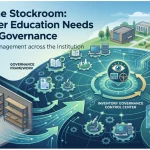
True operational control requires moving past basic inventory management software into an Inventory Governance and Traceability Platform designed to provide enterprise-grade inventory discipline, visibility, and audit readiness without ERP complexity.
Inventory governance shifts the focus from recording transactions to controlling the lifecycle of the asset. It bridges the critical middle ground between fragile, manual spreadsheets and over-engineered, slow-to-deploy ERP modules.
The 4 Pillars of a Governance-First Architecture
To permanently close the reality gap and achieve definitive compliance, an organization must embed strict internal controls directly into the physical movement workflows. This is achieved through four core differentiators:
1. Blind Inventory Audits (The Integrity Standard)
The only way to achieve absolute audit defensibility is to eliminate worker bias entirely. A governance-first platform masks system quantities completely during a physical stocktake. Field teams are only told what item to count and where, forcing them to perform a literal, physical count to enter the number. If a variance is detected between the masked system ledger and the physical input, the system freezes the discrepancy and forces it through a restricted, guided adjustment workflow backed by an immutable digital audit trail.
2. Hard-Coded Governance Gates
Segregation of duties cannot be a theoretical policy in a company handbook; it must be hard-coded into the software workflow from day one. Sensitive inventory actions-such as high-volume checkouts, warehouse transfers, or stock disposals-must trigger automatic, multi-level approval workflows based on role-based access controls. A warehouse technician can initiate a transfer, but the asset cannot leave the digital ledger until an authorized operations manager approves the gate.
3. Dedicated Rejections Management
Inventory discipline starts at the loading dock. Many organizations suffer massive value leakages because damaged, incomplete, or sub-standard materials are accepted into the main stock ledger with the intent of sorting out vendor credits later. A dedicated rejections module mandates quality segregation at the point of check-in, tracking vendor non-compliance, tagging specific reasons for rejection, and ensuring defective items never mix with allocatable enterprise stock.
4. Zero-Baggage Operational UX
If the software is difficult to use, the data entering your system will be flawed. Operational teams need mobile-first, clean execution workflows built for speed and clarity. By stripping away financial and procurement baggage from the front-end user experience, organizations dramatically reduce training effort, eliminate human data entry errors, and accelerate front-line user adoption.
The Strategic Path to Total Asset Visibility
Deploying a monolithic ERP expansion to solve inventory discrepancies often results in a multi-month implementation bottleneck, high consulting costs, and eventual user rejection due to over-engineering.
By contrast, an independent, governance-first platform allows organizations to achieve rapid time-to-value and a faster ROI. It operates as a specialized operational layer that handles the granular complexities of physical inventory-including batch management, barcode tracking, expiry date monitoring, and material planning while seamlessly feeding clean, accurate, “audit-ready” data back to the central business system 365 days a year.
Stop guessing where your operational value is leaking. Stop treating your largest working capital asset as an afterthought in a financial ledger.
By implementing an autonomous inventory governance framework, enterprise leaders can finally move from reactive damage control to proactive, intelligence-driven asset optimization-ensuring that what is written on the digital ledger is exactly what sits on the physical shelf.